Is Religion Dying With Us?
When Faith Fades:
What America’s Shift Means for Funerals —
and How Mueller Memorial Stays Grounded
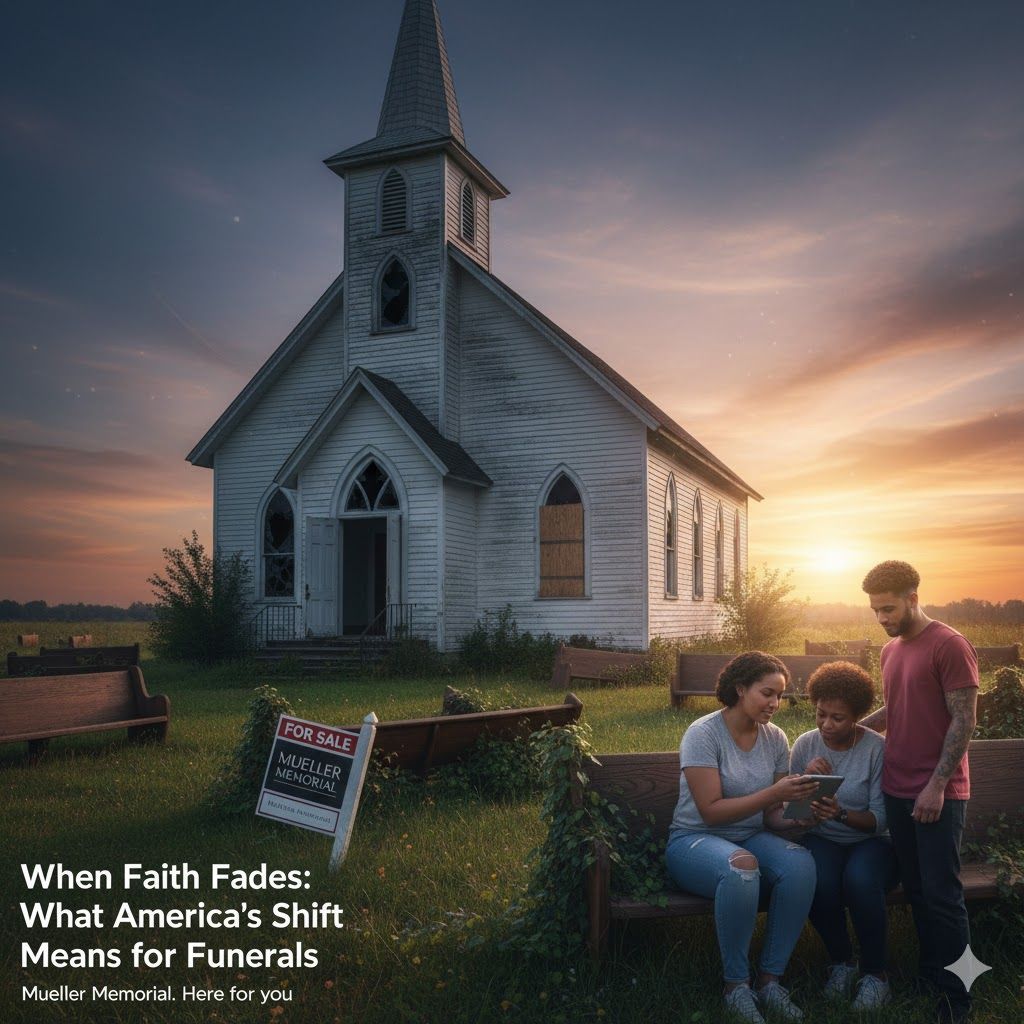
What happens when fewer people turn to faith in life — but still need comfort in death?
A recent Gallup poll reveals a dramatic shift: fewer than half of Americans now say religion is important in their daily lives — a drop of 17 points in just the past decade. Churches are closing, and more people, especially younger generations, are walking away from organized religion altogether. But when someone dies — when the floor drops out and families are faced with loss — that’s often when the big spiritual questions rush in, whether we expect them or not.
At Mueller Memorial, we see this shift firsthand. And we’re not alarmed — but we are paying attention.
FAITH IN AMERICA: A TURNING POINT
The United States has long been considered a religious country, especially when compared to other wealthy nations. But that’s changing — fast. Gallup found that just 49% of adults now say religion plays an essential role in their lives, down from 66% in 2015. That’s one of the steepest declines in the world.
Churches are closing at record rates. More Americans are identifying as “nones” — meaning no religious affiliation at all. And while Christianity still makes up the majority, it’s shrinking: just 62% of Americans now identify as Christian, down from 78% in 2007.
And yet… when someone dies, religion often finds its way back into the room.
FAITH AND FUNERALS — STILL INTERTWINED
We’re not surprised when families say, “We’re not very religious, but…” followed by, “Dad would want a church service” or “We’d still like a pastor to speak.” Even people who don’t attend services regularly often return to familiar rituals during a funeral. It’s not about doctrine — it’s about meaning, comfort, and connection.
At Mueller Memorial, we work with families across the spiritual spectrum — from deeply devout to totally nonreligious. Some want a full Catholic Mass. Others want a simple gathering with favorite music and shared memories. And some need help figuring out what feels right at all.
That’s where our approach makes a difference.
MUELLER MEMORIAL’S RESPONSE TO A CHANGING CULTURE
We’re not here to push anyone into a religious box. Instead, we focus on three things that transcend belief systems:
- Comfort-first spaces – Funerals aren’t meant to feel cold or clinical. We’ve invested in our facilities to create warm, welcoming environments where families can simply be — whether they’re praying, laughing, crying, or all of the above.
- Acute Loss Period support – That first 10 to 12 days after a death is overwhelming, especially without the structure faith used to provide. Our team guides families through every step, offering clarity, calm, and care when it's needed most.
- The Grief Compass – Grief doesn’t end after the service. Our ongoing support program helps families navigate life after loss — without relying solely on faith institutions to do that heavy lifting.
WHAT THIS MEANS FOR YOU AND YOUR FAMILY
Whether your family is deeply religious, spiritual-but-not-religious, or totally secular, one truth remains: the death of someone we love shakes us to the core. And everyone deserves a funeral that feels authentic, comforting, and true to the life that was lived.
At Mueller Memorial, we’re not bound by tradition — but we do honor it. We create meaningful, personal services that meet people where they are, with or without a church pew.
So if you’re not sure what kind of service your family would want — or how to even begin thinking about it — that’s okay. You’re not alone. And we’re here to help.
IN A WORLD WHERE FAITH IS FADING, LOVE STILL SHOWS UP
Even as religion’s role in daily life declines, love, memory, and connection still matter deeply. That’s what funerals are really about. And that’s what Mueller Memorial is here to protect — no matter where you fall on the faith spectrum.
If you have questions or just want to start a conversation, we’re ready when you are.